Korean Templestay: Your Honest Guide to a Real Reset
Is a templestay actually restorative, or is it just something that photographs well and gets crossed off a list? If you have been scrolling through Korea itineraries and keep seeing 'templestay' wedged between a palace tour and a shopping afternoon, you are right to be a little skeptical about whether one night in a temple can genuinely reset a frazzled traveler.
Here is the honest answer: it depends entirely on which program you book and what you are hoping to get out of it. A templestay can be a shallow, rushed add-on if you pick the wrong format, or it can be one of the most useful decompression points in your whole Korea trip if you pick the right one and go in with realistic expectations.
This guide breaks down what a templestay actually involves, where you can realistically book one from Seoul, what it costs, and the etiquette details that nobody mentions until you are standing in a temple courtyard unsure whether you are allowed to take a photo.
What Exactly Is a Templestay, and Is It Right for You?
Templestay is an official cultural program run by the Cultural Corps of Korean Buddhism (https://eng.templestay.com), the organization affiliated with Korea's Jogye Order that coordinates overnight stays at roughly 140 participating temples around the country. It is not a hotel with a Buddhist theme. You are staying inside a functioning monastic space, following its schedule, and eating its food.
There are generally two formats, and knowing the difference matters. A relaxation-type program has no fixed schedule beyond meals and lights-out, so you can wander the temple grounds, sit in the meditation hall, or just sleep. An experience-type program runs a full traditional day: predawn chanting, formal meditation, a monastic meal, and often a tea conversation with a monk.
If you want deep rest with minimal structure, choose relaxation-type. If you want to actually understand what monastic life feels like, choose experience-type, but go in knowing it starts before sunrise and involves real physical stillness, not a spa day.
The Korea Tourism Organization (https://english.visitkorea.or.kr) promotes templestay as one of the country's flagship wellness tourism programs, and interest from international visitors has grown steadily as more temples add English-language sessions.
What Does a Typical Day (and Night) Actually Involve?
You will usually arrive in the afternoon, change into a temple-provided vest and pants, and get an orientation on temple etiquette before anything else happens. Dinner is early, often around 6 pm, and it is eaten in near-silence.
If you are on an experience-type schedule, expect a wake-up call around 3 to 4 am for yebul, the morning chanting service, sometimes followed by 108 bows. This is the part that surprises most first-timers, and it is worth explaining why it exists rather than just listing it: the repetitive bowing is a physical meditation, meant to quiet the mind through the body rather than through willpower alone, which is a genuinely different experience than sitting cross-legged and trying to think of nothing.
After that comes chamseon, seated meditation, and often a formal tea ceremony where a monk answers questions, which tends to be the most memorable part for visitors because it is the one unscripted, conversational moment in an otherwise structured day. Meals follow barugongyang, a formal communal eating ritual where you finish everything on your plate, including the water used to rinse your bowl, because nothing is meant to go to waste.
Lights-out is early, usually around 9 pm. If you are hoping for a late night out afterward, a templestay is the wrong night to schedule it.
Where in and Around Seoul Can You Actually Book One?
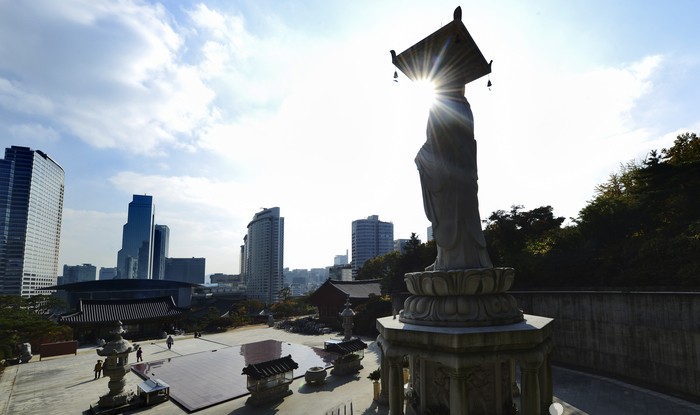
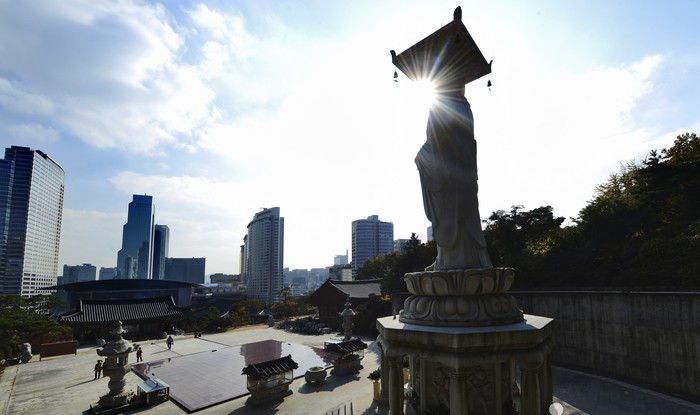
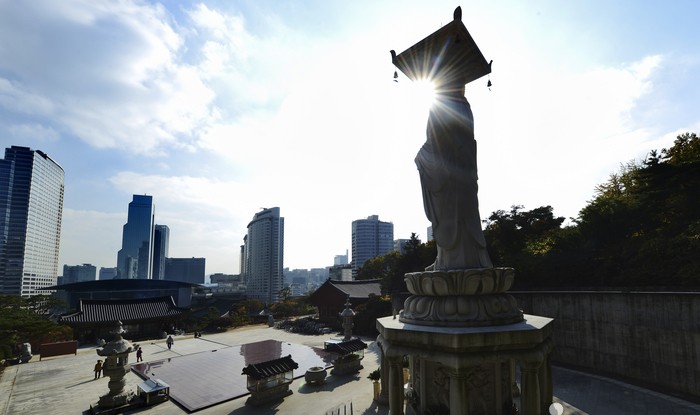
You do not need to leave the city to try this. Bongeunsa Temple, located in Gangnam near COEX and reachable directly from Bongeunsa Station on Seoul Subway Line 9, runs templestay programs that are popular specifically because they let you compare a fifteenth-century temple courtyard with the glass towers surrounding it, all in the same afternoon.
Myogaksa Temple, closer to central Seoul, is known for running English-friendly sessions aimed at international visitors who want the cultural content explained clearly rather than through a language barrier.
If you have more time and want a program further from the city, mountain temples in Gangwon and Gyeongsang provinces tend to offer longer, more immersive stays, but that means factoring in a train or bus transfer of two to four hours each way. For a first templestay, staying inside Seoul removes that friction and lets you test whether the format suits you before committing a full travel day to a rural temple.
All bookings run through the Cultural Corps of Korean Buddhism's official site (https://eng.templestay.com), which lists real-time availability, program type, and whether English guidance is provided at each temple.
What Should You Pack, and What Will It Cost?
Cost is one of the more reassuring parts of this. According to the Cultural Corps of Korean Buddhism (https://eng.templestay.com), most programs run roughly 50,000 to 100,000 KRW per night, depending on the temple and program type, which works out to about 40 to 75 USD. That typically covers your room, meals, the provided temple clothing, and all program activities, so there are few hidden add-on costs the way there can be with guided tours.
Pack layers, because temple floors and unheated meditation halls can run cooler than city buildings, even in warmer months. Bring modest clothing that covers your shoulders and knees for the parts of the day before you change into temple attire, and skip strong perfume or cologne, since scent carries in quiet, enclosed halls.
You will sleep on a floor mat rather than a bed in most temples, which is worth knowing in advance if you have knee or back issues, since some programs can accommodate this with advance notice but not all can.
Leave valuables and anything you are precious about at your main accommodation. Storage at temples is typically a shared cubby rather than a locked safe.
What Are the Etiquette Rules Nobody Tells You About?
Photography is the one that trips up the most visitors. Photos are generally fine in outdoor courtyards, but many main halls, meditation rooms, and the moments around chanting or bowing are off-limits for photos out of respect for people actively practicing. If you are not sure, ask your program guide before raising your phone, rather than assuming a beautiful shot is worth the disruption.
Silence is taken seriously during meals and early morning hours, not as a punishment but because the whole rhythm of the day is built around reducing noise and stimulation, which is the actual mechanism behind why people leave feeling calmer. Talking through it defeats the purpose you came for.
Dress modestly throughout your stay, even during free time, since you are a guest inside an active place of worship rather than a themed attraction. And if a monk or staff member gives you an instruction mid-activity, such as how to hold your hands during a bow, follow it in the moment rather than waiting to ask questions until the tea ceremony, when there is space built in for exactly that.
None of this is meant to be intimidating. Temples that run these programs are used to first-timers making small mistakes, and the orientation session at the start of your stay covers most of this directly.
Final Thoughts
So, is a templestay worth it? Honestly, that comes down to what kind of traveler you are and what kind of rest you actually need. Someone who wants total stillness and a genuine break from decision-making all day will get a lot out of the structured, experience-type schedule. Someone who wants a quiet night and a beautiful courtyard without a 3 am wake-up call is better served by the relaxation-type option, and there is no wrong answer between the two.
What matters most is being honest with yourself about your own travel style before you book, rather than choosing based on which version photographs best. A one-night stay chosen well can be the calmest point of an otherwise packed Korea trip. A one-night stay chosen for the wrong reasons can just feel like an early bedtime in an unfamiliar building.
Not sure yet whether a slow, structured reset like a templestay actually matches how you like to travel, or whether you're more of a move-fast, see-everything type?
Take the quick HBTI travel style quiz to find out which kind of Korea trip, and which kind of rest, actually fits you.
Find your Korea travel style →